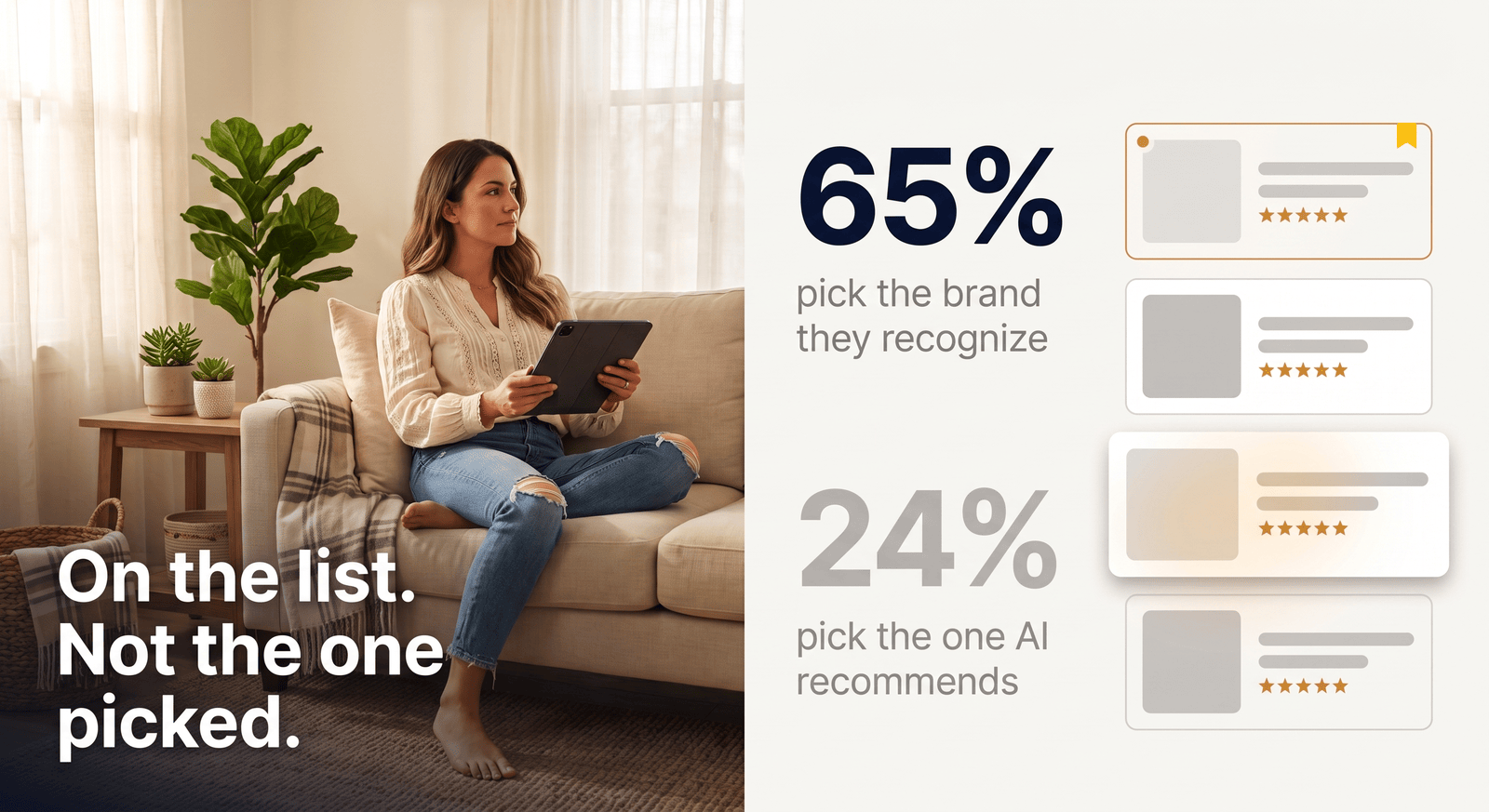
In 12 of 14 categories that OtterlyAI measured this summer, the brand the model actually recommends bought zero ChatGPT ads. That is not caution, and it is not slowness. It is arithmetic. When an AI hands a shopper several options, 65% click the brand they already know, and no ad slot inside the answer can buy that.
The paid layer itself is real and loud. Ads now appear in 76.4% of shopping answers, ChatGPT Ads hit a billion-dollar annualized run rate in under 200 days, and the self-serve Ads Manager opened to US businesses in May 2026 with no minimum spend. Most teams read that as a new performance channel and started pricing a media plan. The data says there are two budgets, not one, and the leaders are spending on the one you cannot win at auction.
What actually decides the click
That number comes from Bazaarvoice’s Brand Equity Survey with Kiri Masters, released on September 15, 2026, across more than 3,600 shoppers in the US and EMEA. When an AI presents several options, 65% click the brand they already know, 24% click the one the model calls its best match, and 11% click the cheapest. The leaders can stay out of the auction because they already win the click the ad is trying to buy.
So the work splits into two jobs with two different owners. The first job is getting into the set. That is citation, crawlability, proof, and clean feed and review structure, and it has a hard floor: if your product pages will not render for a crawler, you are not in the answer at all, which I covered in why your JavaScript site is invisible to AI crawlers. The second job is getting picked once you are in the set, and that is recognition built before the query was ever typed.
The proof requirement for the first job is measurable now. Bluefish and Bazaarvoice looked at 237,804 AI citations from September 1 to 7, 2026, and found that of the product pages the engines cited, 59% had 100 or more reviews, 92% were rated 4 stars or higher, and 65% showed a review summary at the top. So getting into the set is winnable with real work. Here is the uncomfortable part. You can do all of it, get cited, get named the best match, and still lose to the brand the shopper already trusted. A quarter of the clicks against two thirds.
Why the slot inside the answer is weaker than the slot on a search page
If recognition wins the click, the obvious counter is to buy the slot and manufacture the presence. That is where the second half of the leaders’ silence comes in, because the slot inside an answer is structurally weaker than the slot on a search page. A search ad sits next to ten blue links the user already distrusts a little. The page is a list, the user does the judging, and everyone understands the ad is an ad. An answer works the other way. Its entire value is that something did the judging for you. So an ad placed inside it is not competing for attention. It is borrowing credibility from the judgment, and people notice the loan.
The survey data is consistent on this. Ipsos asked 1,085 US adults in January 2026 and found 63% agreed that ads in AI search results would make them trust those results less, 27% strongly and 36% somewhat, against only 24% who disagreed. Semrush, in its July 2026 survey of 2,338 consumers, found that among people who dislike chatbot ads, 66.05% said the ad made them doubt the integrity of the whole response. The same study found chatbot ads pushed more people against a product than toward it, 23.12% who thought worse of it versus 20.36% who thought better.
To be fair to the other side, the picture is not unanimous. OpenAI reports no measured impact on its trust metrics and low ad dismissal rates, and a Zappi survey found 82% of AI-assistant users considered those ads at least as trustworthy as Google Search advertising. I think that makes the Ipsos and Semrush numbers land harder, not softer. Even with a platform reporting clean internal metrics, a majority of people say the ad costs the answer some trust. The implication is blunt. A sponsored slot cannot repair a bad organic answer, and it can make the organic answer around it less believed. That is a cost no ad platform will ever put on your dashboard.
So who is actually buying the ads
Plenty of brands are buying, which is why the layer looks so crowded. OtterlyAI’s July 2026 study looked at 16 US industries in ChatGPT and found ads in 76.4% of shopping-related answers, holding between 77% and 82% every day across a two-week window. That steadiness matters. A number that stable is a feature of the product, not a test someone might roll back. The average hides the decision, though. Saturation runs from 85.9% in Finance and Insurance down to 42.3% in Healthcare, two categories that call for opposite moves.
Look at who bought the slots and the picture sharpens. The heaviest advertisers were BestMoney, LegalZoom, Angi, Shiply, and Top10.com. Those are intermediaries and comparison sites, not the brands a shopper ends up buying. BestMoney alone appeared in 15 of 16 industries and took 36.4% of all ad placements in Finance. The end brands that do buy skew toward challengers expanding share, names like Robinhood, SoFi, L.L.Bean, and Alo, not the incumbents defending the top of the category. This is the same money moving that I wrote about in how AI search is forcing paid back upstream. The capture layer is shrinking, and the spend is going somewhere. It is going to the brands that do not yet own the recognition, which is exactly the tell.
What it costs to skip the brand half
Being the unknown option has a price, and the Bazaarvoice study names it. 57% of shoppers said a generic alternative has to be priced at least 50% below their usual brand before they would consider switching. Read that as a margin line, not a branding one. An unfamiliar brand pays a discount to win the customer that a recognized brand gets for free, and that discount comes out of gross margin on the first order, not out of a media budget where anyone would see it.
There is a second trap under it. A discounted first order only counts as acquisition if a second order follows. If it does not, you did not acquire a customer, you sold one unit at a loss. So pull repeat rate on discounted cohorts on their own and put a real payback period on them, the way I laid out in the cohort payback period. This is also why a low-price challenger cannot discount its way to the recognition an established brand already owns, the argument in the luxury playbook for the $99 dress. And the discount is not even buying an impulse. 94% of shoppers do their own research after an AI recommendation, and a third of them spend more than an hour on it.
The receipt
At a large retailer I ran growth for, branded keyword volume was shrinking at an accelerating clip, and store traffic was sliding with it. Read on a performance dashboard, it looked like a conversion or a media efficiency problem. It was neither. It was an awareness problem showing up in a performance report, which is the most expensive place to find one.
I argued for moving money up the funnel, ahead of the moment of need, into placements that build recognition instead of harvesting it. The part that stuck with me came later. When AI engines started citing the brand, the shoppers who saw those citations had almost always seen the brand somewhere else first. The citation confirmed the brand. It did not introduce it. The answer layer was reading back the recognition we had already paid to build, and it would have had nothing to read if we had waited for it to do the introducing.
How to fund and measure this without fooling yourself
Four moves make this a budget decision instead of a slogan.
Split the budget explicitly. Name one owner for answer-layer presence and a separate owner for recognition. Most orgs staff the first and fund the second out of whatever is left, which is how the recognition half quietly starves.
Decide per category, not per brand. If your category is running at 85% ad saturation, the paid slot is contested and you may need it defensively. At 42%, earning the recommendation is cheaper than buying your way around it. The blended number cannot make this call for you.
Treat branded search volume and direct sessions as your brand meter. They are lagging, they are unglamorous, and they are the earliest honest signal that recognition is eroding. A branded-query trend that is bending down is an awareness problem arriving about eighteen months before it hits revenue.
Do not grade the answer-layer ad on its own reported number. It will look good for the same reason retargeting always looks good, by taking credit for demand that already existed, which is the whole problem I set out in platform ROAS is grading its own homework. If you want to know whether the brand spend actually worked, hold out a geo and read the whole business, not the channel.
The answer layer put a price on being in the set, and a much larger price on not being recognized once you are there. The money that used to buy the click now has to buy the memory that makes the click happen, which is the demand-creation job I described in demand generation versus demand capture. So the question for your next budget is which of those two you are funding, and who owns the other one.