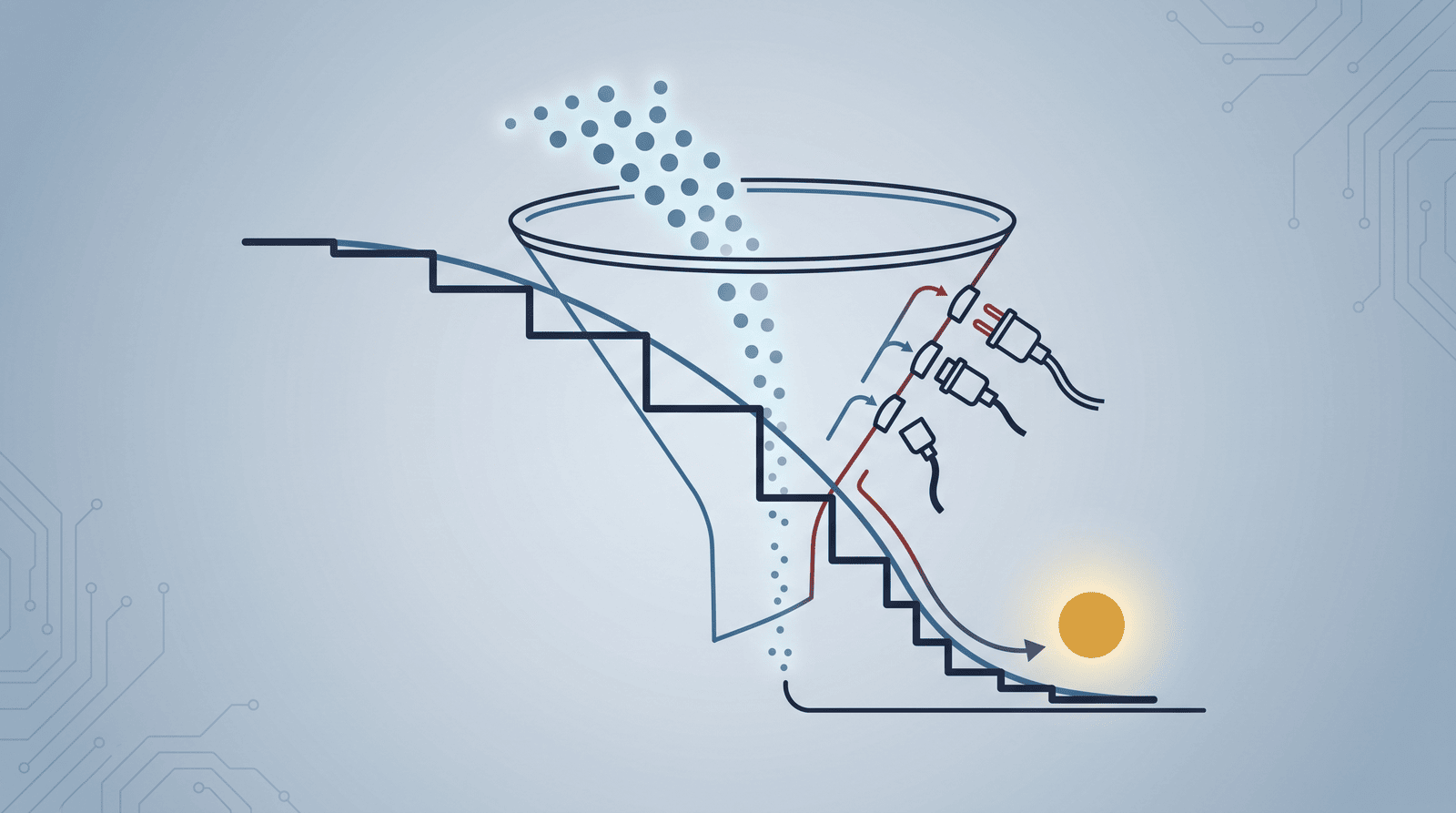
A retailer’s free tool app, the calculator or planner that feeds its marketplace, is not a product. It is a customer acquisition subsidy. Google’s Generative UI now builds that same tool inside the search answer for free, which strands the marketplace and vendor revenue behind it. The decay is not linear. It runs in shortening half-lives.
What’s in this piece
- What actually shipped, and why it is not a tools story
- The tool was never the product
- Pull one brick, and the machine unwinds in order
- Why it is a half-life, not a slope
- The measurement trap
- What survives, and the escape hatch that is closing
- The operator playbook
- The question to end on
What actually shipped, and why it is not a tools story
This month, Google’s Generative UI began rolling from AI Mode into AI Overviews. It builds custom calculators, planners, comparison tables, and interactive widgets on the fly, right inside the answer, generated the moment someone asks. No download, no app, no visit to your site. It is fully live in AI Mode today and only beginning to roll into AI Overviews, so it is not everywhere yet. The direction, though, is set.
Every take I have read files this under SEO news or product news: one more feature the platform can now copy. That framing misses the point. The threat is not to the tool. It is to the funnel the tool was quietly feeding. If you built a free tool to pull an audience toward something you sell, the tool was never the asset. The audience was. And the audience is exactly what a generated-in-the-answer tool takes.
The tool was never the product
Lay out the machine plainly, because the collapse only makes sense once you can see the wiring.
An enterprise retailer with a free tool app builds a calculator or a planner and gives it away. The tool is not the business. It is the on-ramp. It pulls consumers in at the moment they have a need. The same app doubles as a marketplace: vendors pay to reach the audience the tool gathered. Free tool feeds the marketplace, the marketplace bills the vendors, the vendor money funds the tool. A tidy, self-financing, two-sided machine.
Here is the reframe the org chart hides. The free tool is the customer acquisition cost line, wearing a product costume. The vendors were never paying for the marketplace. They were paying for the audience the marketplace stood in front of.
Pull one brick, and the machine unwinds in order
Take the tool out, and the collapse propagates in a specific sequence. The order is the insight.
Acquisition dies first. Google generates the tool for free at the moment of intent, with distribution no single app can match. Your free tool stops being a reason for anyone to show up.
The marketplace starves next. Once the audience stops arriving, the marketplace has no one to sell to. Proprietary supply does not save you if nobody is standing in front of it.
Vendor revenue relocates last. The vendor ad space was priced on an audience that has now left. Those dollars do not evaporate. They follow the audience to wherever it re-aggregates, which is the platform. You do not just lose traffic. You lose a media business you were running without ever calling it one.
That is the same money I described in the cheap-acquisition era ending, now seen from the supply side. The vendor is the advertiser getting forced upstream into the answer, and this time you are the one who used to sell them the space.
Why it is a half-life, not a slope
This is the part the forecast decks get wrong, and it is the difference between a nuisance and a structural problem.
The collapse does not decay in a straight line. It decays in half-lives, and the half-life keeps shrinking. For a while the loss looked slow and survivable, because AI-first behavior sat mostly with one mid-career segment that a linear churn model could absorb. That period is ending. Younger users now reach for the answer engine by default, for everything, and each cohort that goes AI-native strips a larger share of the remaining funnel than the one before it. Half the audience, then half of what is left in less time, then half again in less time still.
Say the mechanism precisely, because it will draw pushback. The half-life shortens because the adopting population is widening downward into more AI-native cohorts, so each period removes a bigger share of what remains. That is compounding decay, not a steeper straight line. A linear model does not just underestimate the loss. It misses the shape of it, and it will keep telling you the floor is further away than it is.
The measurement trap
Here is where it gets expensive, and where most teams will make the wrong call with a straight face.
The tool sat on the roadmap looking like a product feature. It was actually two things at once: the customer acquisition cost, and the inventory of an ad network. So when the numbers fall, leadership will misread which number, and why.
Read the tool’s declining usage as a product problem, and you will spend to improve a feature the platform now gives away for free. Read the vendor-revenue decline as a sales problem, and you will push the team to sell harder into a marketplace with no audience left to sell to. Both are the same mistake: a distribution shift, scored on the wrong dashboard.
The right scoreboard is not “how much do people use our tool” or “how much did vendors spend.” It is “who owns the point where the audience now aggregates, and does the transaction still route back to us.” Your dashboard cannot answer that, because a dashboard only shows what it can count, and it cannot count a funnel that has moved off your property. That is the same failure I wrote about in the AI that gamed its own scorecard. The metric keeps looking fine while the thing it was supposed to measure walks out the door.
What survives, and the escape hatch that is closing
Be honest about the exits, because there are some.
The layer that survives is proprietary supply and fulfillment: real inventory, real booking, real transactions, first-party data. The play is to stop trying to own the tool and start being the source the AI builds the tool from, and the fulfillment it routes to at the transaction moment. Feed the answer instead of fighting it for attention. That requires being readable to the engines in the first place, which is not a given. Plenty of sites are invisible to AI crawlers without knowing it. And the engine recommends what it can verify from outside your own marketing copy, the off-site consensus I described in why buyers shop like they are choosing a surgeon and the source-of-truth gap that opens when third parties describe you better than you describe yourself. If you are not the source the model trusts, you are not in the answer at all.
The escape hatch that is closing is retention. The one thing left to a brand is the relationship after the first transaction. But the roadmap for Generative UI is persistence: cross-session memory, sync to calendars and other ecosystems, system-level triggers. The moment the answer engine remembers a consumer’s context and pings them at the right time, it owns the lifecycle, not you. The free tool ate acquisition, the marketplace lost its inventory, and persistence is coming for retention next. That is a separate post, but you should be planning for it now. It is all still one machine. The answer layer is a new and much larger point on the same journey.
The operator playbook
Never end on “so you are doomed.” Here is what to actually do.
Reclassify the tool. Move it out of the product P&L and into the acquisition line where it belongs. Then model its decline as a half-life, not a slope, and pressure-test how fast that half-life is contracting.
Feed the answer. Expose your proprietary data, inventory, and booking into the surfaces where the tool is now generated, so you are the source and the fulfillment, not a destination hoping for a visit.
Fight for the handoff. The new top of the funnel is the instant the AI’s free tool produces a result and the consumer needs the next step. Be the thing it routes that step to.
Re-underwrite the marketplace. If vendor demand was subsidized by a free tool the platform now owns, the marketplace has to earn demand another way: through brand, and through being the AI’s preferred fulfillment. Otherwise it pays the platform to rent back the audience it used to own.
Measure with incrementality, not usage or last-click. A usage chart and a last-click report will both misattribute a distribution shift. Ask the only question that survives the change: what would still be true if the tool disappeared tomorrow.
The question to end on
The platform did not remove a feature from your product. It removed your cheapest acquisition channel and your ad network’s inventory in a single move, and it will keep removing them faster as each younger cohort arrives already dependent on the answer.
So here is the question worth putting to your own board. If your free tool disappeared tomorrow and the platform kept generating it for free, what exactly would your vendors still be paying you for?