Ask ChatGPT about your products and it will answer confidently. It will name your categories, describe your range, quote a price. It sounds like it knows you well.
It has never read your website.
That gap, between what an AI can say about your brand and what it has actually seen of your brand, is the quiet crisis of AI search. Because when the engine can’t read your site, it doesn’t stop talking about you. It fills the space with whatever it can read: search-engine caches, months-old training data, and third-party pages like reviews and forum threads. Your live catalog, your real prices, your newest collection, all of it sits on the far side of a wall the AI never gets past. And so your brand ends up narrated by everyone except you.
Where the answer actually comes from
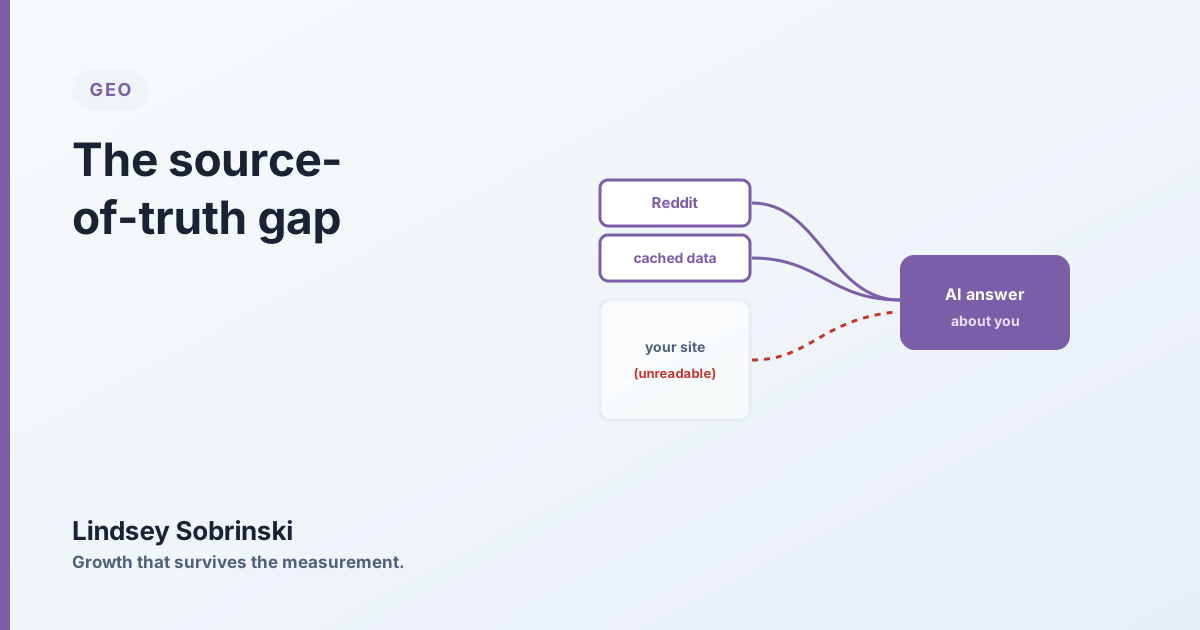
When an AI describes your products, the information is assembled from a few sources, and on a JavaScript-rendered site your own pages usually aren’t among them. AI crawlers don’t execute JavaScript, so if your content only appears after the script runs, they arrive at an empty shell. What’s left for the model to work with is everything around your site: Google and Bing’s cached snapshots, the training data baked in months or years ago, and third-party content that happens to be readable, the roundups, the review sites, the Reddit threads where people discuss your category.
That material is doing the job your product pages should be doing. And it comes with the failure modes you’d expect from secondhand information.
What secondhand data gets wrong
Stale prices and availability. The model is working from cached and trained data, so a dress that sold out last week still gets recommended, and a sale price from two seasons ago shows up as current.
Missing new collections. You launched this month; the AI won’t know for weeks or longer. To an AI shopper, your newest products don’t exist.
Competitor contamination. With no direct data, the model fills gaps from comparisons and roundups, and other brands get named inside answers about you.
No control over the narrative. You can’t correct any of it, because you were never the source. The AI assembled the answer from fragments, and the fragments are what they are.
None of this is the AI being careless. It’s the predictable result of an engine describing something it can’t see, using the only material it can reach.
When Reddit does the work your site should
Here’s the part that reframes it. On one enterprise brand, the thing actually driving its visibility in AI answers wasn’t the brand’s own site, it was third-party threads. When AI engines answered questions about the category, the seeded discussions and roundups were among the sources being cited. The brand had, in effect, outsourced its own catalog to strangers.
That’s not a knock on third-party corroboration. Corroboration is essential to AI visibility, it’s how a model decides your brand is worth mentioning at all. The problem is corroboration without a readable site. The mentions tell the engine you matter, then point it at a site it can’t actually read, so the specifics, the prices, the products, the accurate description, never get verified against the real thing. Reddit was carrying the whole narrative, and pointing at a brand the AI couldn’t confirm.
Becoming the source of truth again
The fix is to close the loop, and it has two halves.
First, make your own site directly readable. Serve full HTML to AI crawlers, through server-side rendering or a prerender layer that hands bots a fully rendered page, so your live products, prices, and reviews are visible to them. This is the half most brands skip, because their site looks fine in a browser and no one thinks to check what a crawler sees.
Second, keep earning the off-site corroboration, but now it points at a site the engine can verify. The mentions create the trust; the readable site supplies the facts. Together they form a closed loop: third parties tell the AI your brand matters, the AI reads your actual pages to get the details right, and it cites you as the source instead of the footnote.
That’s the whole game. Corroboration without a readable site leaves your brand described secondhand and slightly wrong, forever. A readable site without corroboration is accurate but invisible. You need both, and most brands have neither pointed the right way.
Stop letting the AI describe you from stale, secondhand fragments. Make your own site the thing it reads, and let everyone else’s mentions point at a source you actually control.