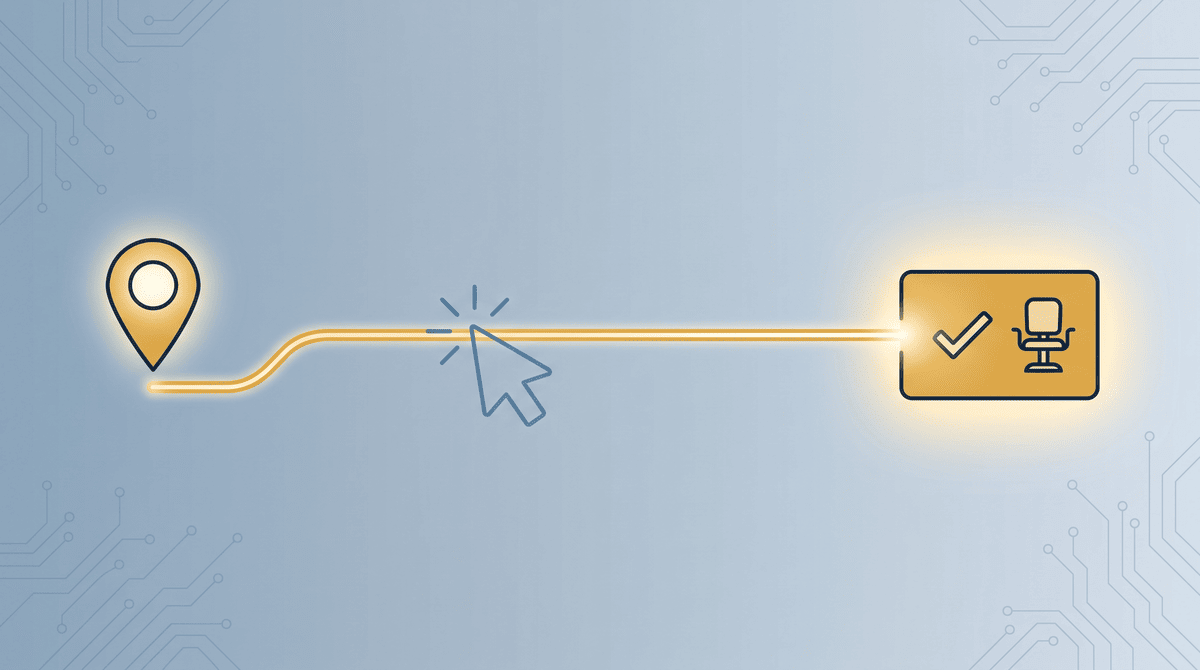
For a business that runs on appointments, ranking and clicks are vanity. The KPI is booked appointments. Optimize the Google Business Profile, the service and location pages, and the booking path for the query-to-booking journey, and measure calls, direction requests, and completed bookings. Traffic that never books is a cost, not a win.
I learned this inside a national bridal retailer, where the real conversion was never a pageview. It was a customer sitting down for a fitting. A location could rank well for every “bridal shop near me” variation in its metro and still miss its number, because the thing that mattered happened after the click: did the shopper find the hours, trust the reviews, and reach a booking button that worked. Ranking got her to the listing. It did not get her into the chair.
What’s in this piece
- Why clicks are the wrong local KPI
- The query-to-appointment journey
- Your Google Business Profile is the real landing page
- Service and location pages that convert to bookings
- The “near me” answer: where local SEO meets AEO
- Measuring what matters: calls, directions, and bookings
Why clicks are the wrong local KPI
A click is a step, not an outcome. For an ecommerce site you can almost forgive the shorthand, because the transaction happens on the page and the click is at least on the path to revenue. For an appointment business the gap between the click and the money is wide, and it is full of places to lose the customer. Someone can click through, discover the next available slot is three weeks out, see a one-star review on the first screen, hit a booking widget that does not load on their phone, and leave. That click counted. Nothing happened.
Measuring local SEO by rankings and traffic optimizes the wrong half of the funnel. It rewards getting seen and ignores getting booked, which means a program can post rising impressions and flat revenue and look like it is working. Worse, it misdirects the work. If the scoreboard is rankings, the team chases position on more “near me” terms. If the scoreboard is appointments, the same team notices that one high-ranking location books at half the rate of its neighbor and goes to find out why. Same inputs, completely different work, because the KPI pointed somewhere else.
The reframe is simple to state and uncomfortable to adopt: traffic that never books is a cost. You paid to earn it in time, content, and attention, and it returned nothing. The goal is not more local traffic. It is more booked appointments from the traffic you already earn.
The query-to-appointment journey
Map the actual path a customer takes, because that is where the KPIs should sit. It has four stages, and only the last one is the win.
A local query starts the journey, often from a phone, often with intent already high: “bridal shop near me,” “alterations downtown,” a service plus a place. The map pack and the Google Business Profile answer it, frequently before the website is involved at all. Then a decision forms, built from the profile and sometimes a landing on the site: hours, distance, reviews, photos, whether this place does the specific thing the person needs. Finally the booking action: a call, a direction request that signals an intent to visit, a tap on a booking button, a completed appointment form.
Each stage leaks. The point of mapping it is to find your leak. A location with strong map-pack presence and weak booking numbers is losing people at the decision or the booking stage, not the visibility stage, and no amount of additional ranking fixes a booking-stage problem. You cannot improve what you have not located, and the journey is the map.
Your Google Business Profile is the real landing page
For a large share of local queries, the profile is the landing page. The decision happens there, inside Google, before a click to your site ever occurs. Treating the profile as a set-and-forget directory entry while pouring effort into the website is optimizing the room the customer never enters.
A profile that converts does the unglamorous things completely. Accurate hours, including the holiday hours that turn a drive into a wasted trip and a bad review. Categories and services that match what people actually search, so the profile is eligible for the right queries. Photos that show the real place, because a shopper deciding between two bridal shops is reading the room before she arrives. Reviews managed as the trust layer they are, with responses that show the business is present. And a working action: a call button, a booking link, directions that resolve. To Google, your business is an entity with attributes, not a bag of keywords, which is the same shift from entities, not keywords that governs the rest of search. The profile is where you state those attributes most directly.
Service and location pages that convert to bookings
When the journey does reach your site, it usually lands on a location page or a service page, and those pages have one job: move the visitor to a booking. Most of them are built to describe, not to convert.
Lead with the answer the query asked. Someone searching a service in a city wants to know, in the first screen, that you do that service in that place, what it involves, and how to book it. That is the local version of answer-first product and category pages: state the thing plainly, up top, before the brand story. Put the booking path where the intent is highest, not buried below a wall of copy. Make the location page specific to the location, with its real hours, its staff, its reviews, its parking and transit notes, because a templated page that swaps only the city name converts worse and ranks worse than one that proves the location exists and is run by people. And make the whole thing work on a phone, because local intent is mobile intent, and a booking widget that fails on mobile fails on the device most of your customers are using.
The “near me” answer: where local SEO meets AEO
Local search and answer engines are converging on the same surface. A “near me” query increasingly returns a synthesized answer, and the assistants that power them are pulling from the same structured signals that feed the map pack: the profile, the reviews, the service and location data, the schema on your pages. Local SEO and AEO are becoming one problem.
The through-line is that both reward a business that has stated its facts clearly and in a machine-readable form. The profile attributes, the service markup, the review data, the location details: these are what an engine quotes when it answers “where can I get this done near me.” Earning the answer-box or the AI recommendation for a local query is the same discipline as winning the answer box anywhere else, applied to place. The business that treats its local data as a clean, declared set of facts is the one that gets surfaced when the format shifts from ten blue links to one spoken answer.
Measuring what matters: calls, directions, and bookings
Close the loop by measuring the outcome, not the input. The Google Business Profile performance report already gives you the profile-side actions: calls, direction requests, and website clicks, and booking actions where you have them connected. Those are closer to revenue than any ranking report, and they are the first place to look when you want to know whether the profile is doing its job.
On the site, instrument the booking flow so that sessions arriving from local search and from the profile are tagged and tracked to completion, and connect completed bookings back to source wherever the booking system allows it. The aim is a line you can draw from a query to an appointment, per location, so you can see which locations convert the visibility they earn and which waste it. That is what turns local SEO from a rankings exercise into a revenue one, and it is the only version of the scoreboard a general manager who thinks in booked chairs will actually trust.
If your local program is still reported in rankings and clicks, the fastest improvement is changing what you measure. The booking data is a local SEO question with a concrete answer. What would change in your local program if the only number on the dashboard was booked appointments?