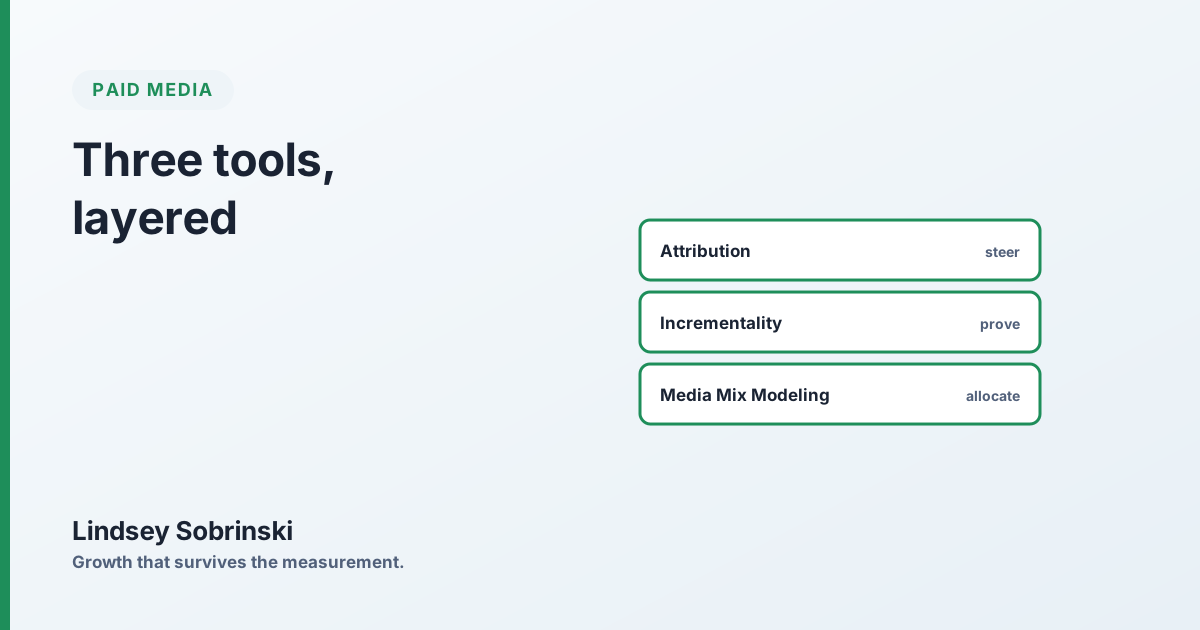
There’s a recurring argument in measurement circles that goes nowhere: attribution versus incrementality versus media mix modeling, as if you have to crown one and retire the others. It’s the wrong frame. They answer three different questions, and a serious measurement program uses all three, each for the job it’s actually good at.
Three questions, three tools
Attribution answers: which touchpoints preceded the conversions I can see? It assigns credit across the clicks and impressions leading up to an observed sale. It’s fast, granular, and available in every dashboard, and it inherits every bit of the platforms’ observation bias, because it can only reason about conversions that were tracked. Attribution is a steering instrument.
Incrementality answers: what did this spend actually cause? It builds a controlled comparison, a holdout, a geo test, an audience suppression, and measures the lift between an exposed group and an unexposed one. It’s slower and narrower, covering one channel over one window, but it’s causal. Incrementality is ground truth.
Media mix modeling answers: how should I allocate across everything, including what I can’t click? It’s a top-down statistical model relating historical spend to outcomes across the whole plan, CTV, out-of-home, audio, and the trackable channels together. It’s coarse and correlational, but it’s the only one that can see the un-clickable channels. MMM is the allocator.
Steer, prove, allocate. Different questions. No winner.
Why picking one always fails
Each tool, used alone, fails in a predictable way.
Attribution alone hands your budget to whichever channel is best at observing conversions, branded search, retargeting, and starves the demand-generation channels that don’t get tracked. You optimize toward a mirror.
Incrementality alone is too slow and too narrow to run the whole plan. You can’t hold out every channel every week; tests are expensive and cover one thing at a time. Ground truth, but not a steering wheel.
MMM alone is correlational and easy to fool. Without experimental calibration it drifts, confidently attributing to a channel whatever happened to move alongside it. A pretty model, unmoored from cause.
The failures are complementary, which is the tell that the tools are meant to be layered.
Attribution is a speedometer, incrementality is a scale, MMM is a map. Nobody argues about which instrument is “right.” You’d never fly with just one.
How they actually stack
The working structure is a loop, not a hierarchy.
Incrementality tests produce causal reads on specific channels, the true lift of retargeting, of branded search, of a CTV campaign. Those reads calibrate the media mix model, anchoring its contribution estimates to experimental reality instead of letting them float on correlation. The calibrated model then allocates budget across the entire plan, including the channels attribution never sees. And attribution steers the day-to-day execution inside that allocation, which creative, which audience, which campaign needs attention this week.
Then you re-run the tests periodically, because channels and markets drift, and a model calibrated a year ago is a model quietly going wrong. Tests prove, the model allocates, attribution steers, and the tests refresh the whole thing on a cadence.
Where this fits
This is the machinery underneath the Measurement lane: not a single magic metric, but three instruments doing three jobs. It’s also how the demand-generation vs demand-capture argument finally gets settled, attribution will always flatter capture, so you need incrementality to prove what generation created and MMM to allocate between them.
Stop looking for the one true measurement method. Build the layered system: fast steering from attribution, causal truth from incrementality, whole-plan allocation from a model the tests keep honest. The teams that win the measurement conversation aren’t the ones with the best single tool. They’re the ones who stopped treating it as a single-tool problem.