A shopper has your product in the cart. Before she checks out, she opens a chat window and types a question she would never have typed into Google: “Is this brand any good, and is there something better?” She reads the answer for fifteen seconds, closes the tab, and either buys or doesn’t. You never see any of it.
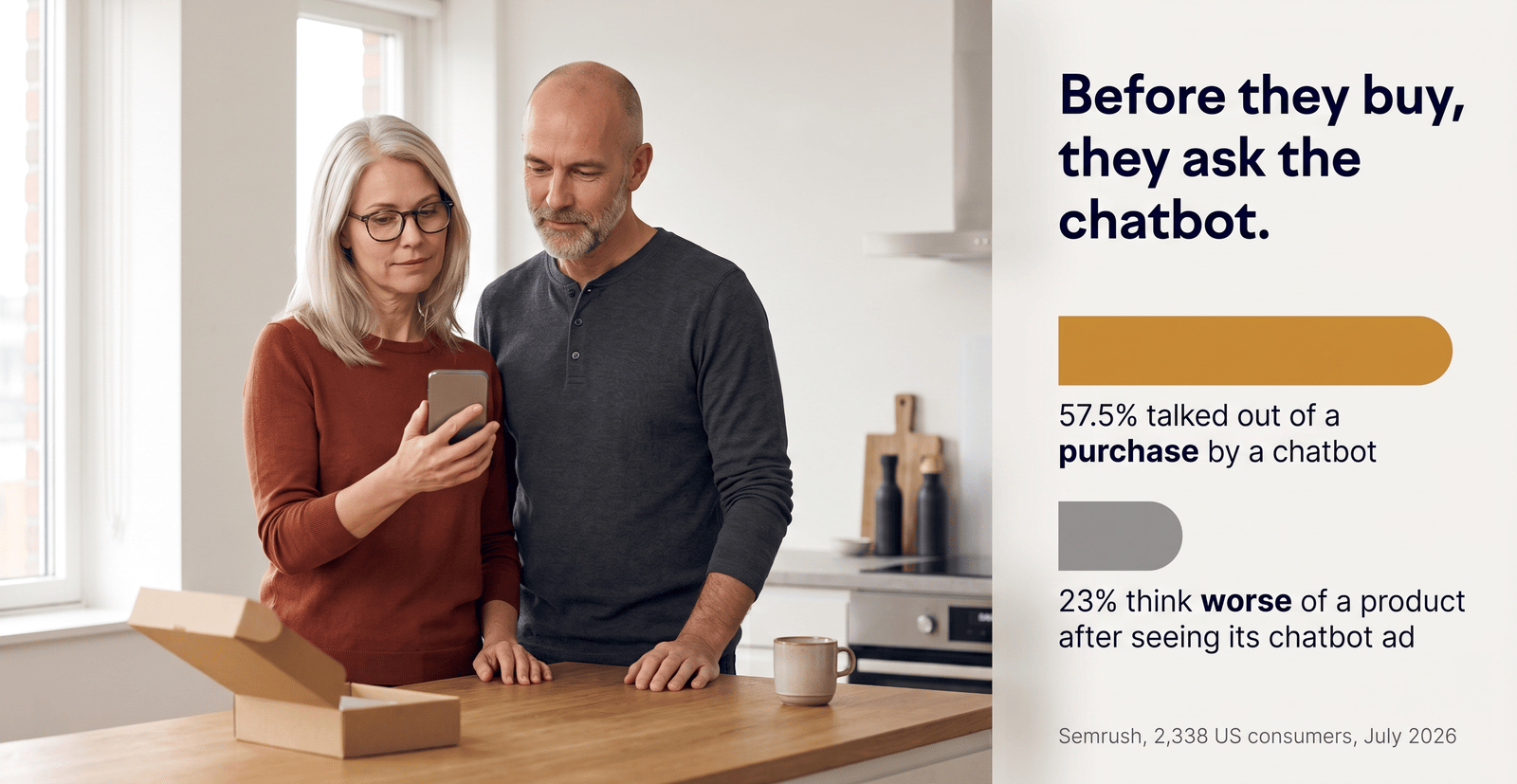
Almost half of consumers now do a version of this before they buy. Semrush surveyed 2,338 US adults in July 2026 and found 47.54% at least sometimes ask a chatbot about the seller first, and 57.5% of AI users have already been talked out of a purchase by one. That step sits in front of your first touch, and no report on your desk shows it.
What’s in this piece
- The report your dashboard can’t show you
- Why you can’t buy your way past it
- The four-step audit
- What to track after the audit
- What this means for the plan
The report your dashboard can’t show you
The chatbot is writing a reference check on you, in real time, for a person who is one tap from buying. It pulls from retailer and third-party reviews, press and earned mentions, retailer product pages, forums and Reddit threads, comparison content, and your own site when it can read it. Your ad is not in that mix. The model is not answering from the message you paid to place. It is answering from the record other people left about you.
That record decides more than you would guess. In the Semrush data, 74.15% of all consumers said they would be less likely to buy if a chatbot flagged mixed or negative reviews, and among AI users it was 85.31%. For a long time the click was the whole job: get the person to the page and the page takes it from there. Now a model decides whether the click happens at all, using proof you built or neglected months ago. I made that argument about budgets in how AI search is forcing paid back upstream. This is the same shift, landing on a single brand instead of a media plan.
Why you can’t buy your way past it
The obvious fix is to buy the slot. Semrush tested that, and the numbers should stop you. Ads placed inside chatbots made more people think worse of a product (23.12%) than better (20.36%). Worse, among the people who dislike chatbot ads, 66.05% said the ad makes them doubt the integrity of the whole answer. So the paid slot does two things you did not want: it fails to repair a bad organic answer, and it can make the surrounding answer less trusted.
Spending harder does not move this. Better proof does. On a fractional engagement I cut a client’s paid dependency 83% while ROAS rose 75%, and the lever was never a smarter media buy. It was fixing what the market could verify about the brand, so the demand showed up already convinced. The model rewards the same thing a good buyer does. It trusts what it can check.
The four-step audit
Here is the part worth bookmarking. You can see what the model says about you, find where it got it, and change it. Budget an afternoon for the first pass.
Step 1. Run the prompts. Write a fixed set of eight to ten questions a real buyer would ask, then run them in ChatGPT, Gemini, and Perplexity, plus Google AI Mode if you sell retail. Use questions like these:
- Should I buy [product] from [brand]?
- Is [brand] legit?
- What are the complaints about [brand]?
- [Brand] vs [top competitor]
- Best [category] under $[price]
- Who makes the best [category] for [use case]?
- Is [brand] worth the price?
- What do reviews say about [hero product]?
Run each one logged out and logged in, run the whole set twice a week apart, and screenshot everything. The answer shifts by engine, sometimes a lot, which is why you check more than one. I got into why the engines disagree in the one-citation play per engine.
Step 2. Score the answer. For every prompt on every engine, fill four columns. Were you mentioned, yes or no. What was the sentiment: recommend, neutral, or warn. What was the exact objection, quoted. Which competitor got named in your place. It looks like this:
| Prompt | Engine | Mentioned | Sentiment | Objection quoted | Competitor named |
|---|---|---|---|---|---|
| Is [brand] worth the price? | ChatGPT | Yes | Warn | “sizing runs small” | [Competitor A] |
| Best [category] under $60 | Gemini | No | n/a | n/a | [Competitor B] |
That table is your share of answer. Keep it in one sheet so you can run it again next month against the same rows.
Step 3. Trace the sources. Where the engine shows citations, write down the domains. Where it doesn’t, ask it directly: “what are you basing that on?” A pattern shows up fast. The objection almost always traces to one or two places: a single forum thread, a cluster of reviews saying the same thing, an old press piece, a retailer page with a stale spec. Then check whether your own site is anywhere in the list. If it isn’t, look at whether your product pages render in JavaScript, because most AI crawlers do not run it and a page that looks fine in a browser can be invisible to the model. I walked through that failure mode in why your JavaScript site is invisible to AI crawlers. When the model can’t read you, it builds your reputation from whoever it can.
Step 4. Fix the source, not the answer. You can’t edit the model. You can edit what it reads. Reply to the review cluster and get the pattern addressed. Update the retailer page. Get the wrong spec corrected. Earn the press mention or comparison piece that answers the objection head on. Make the product page readable to a crawler that doesn’t execute scripts. Then run the prompt set again in 30 days and watch the objection column. One more thing worth knowing: the model vets on proof, not price, so a mid-priced brand with a clean record can beat a cheaper one with a messy one. I made that case in the luxury playbook for the $99 dress.
What to track after the audit
Run the same prompt set on the same schedule, monthly is enough, and trend two things: the share of answers that recommend you, and the number of distinct objections that keep coming up. Those two lines tell you whether the record is getting better or worse while you sleep.
Watch branded search and direct sessions as the lagging signal. When the answer improves, you don’t see a flood of new clicks. You see people arriving already decided, the same quiet pattern as impressions climbing while clicks stay flat. Paid tools for this exist, and Semrush sells one, but the manual audit is enough to start and it makes you read the actual answer instead of a dashboard’s summary of it. There is also a supply-side reading of where the model gets its material: one vendor analysis (Azoma, Q2 2026, no sample size disclosed, so treat it as directional) put ChatGPT’s retail citations at roughly 41% earned media and 37% retailer pages. Both of those are things you can influence and neither of them is your ad.
What this means for the plan
The background check is part of the funnel now, and it runs before you get a first touch. So treat the answer as an asset you own, with a name next to it, the way you would a landing page or a category page. Somebody on the team should be able to tell you what ChatGPT says when a buyer asks whether to purchase from you, and when they last checked. If no one can, that is the gap to close this quarter. What does the chatbot say when someone asks whether to buy from you, and who on your team has actually looked?