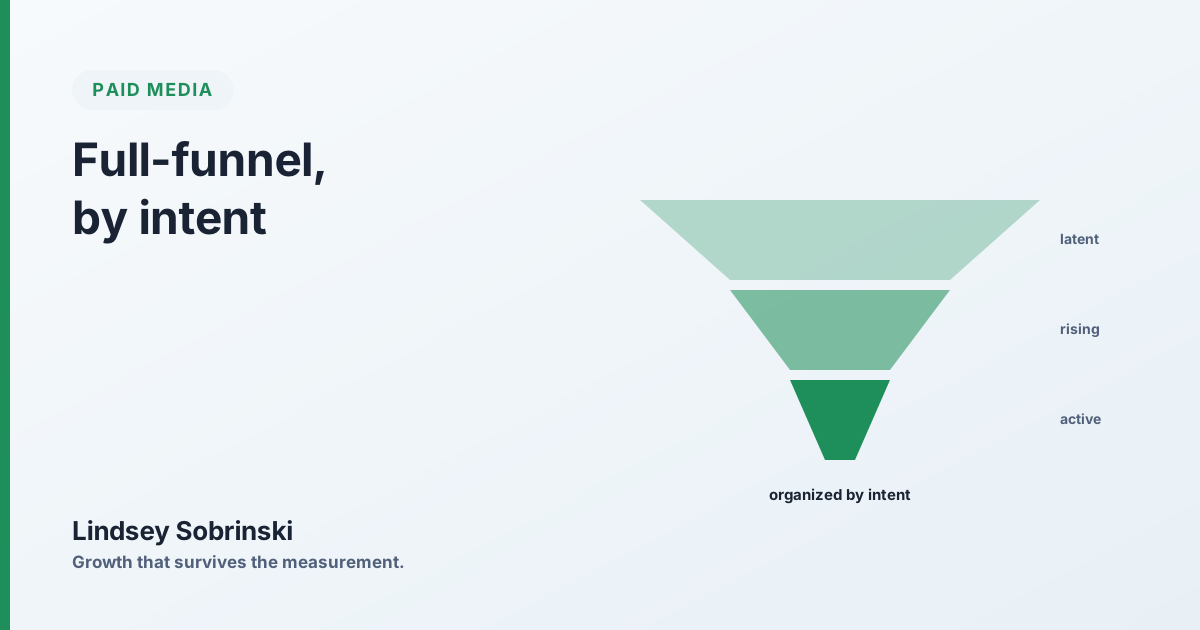
“We’re going full-funnel this year” almost always means “we’re adding CTV” or “we’re finally doing some upper-funnel social.” More platforms, more line items, a top-of-funnel budget bolted onto the plan. That’s addition, not full-funnel, and it’s why so many of these plans quietly collapse back into a bottom-funnel machine within two quarters.
Full-funnel marketing isn’t about how many channels you run. It’s about how the plan is organized. And the organizing principle isn’t the channel. It’s intent, how close a person is to buying.
The difference between addition and organization
Picture the typical plan: a search budget, a social budget, a programmatic budget, each with its own owner, its own target, its own definition of success. Add a CTV line and you’ve technically got top-of-funnel spend. But nothing connects the tiers. Search is measured on ROAS, CTV is measured on reach, and no one asks whether the CTV is what created the demand the search budget is now busily “capturing.”
That’s a stack of channel budgets wearing a full-funnel costume. Real full-funnel work starts by throwing out the channel-first layout and rebuilding the plan around levels of intent: latent demand at the top, rising intent in the middle, active intent at the bottom. Then, and only then, you choose channels to serve the levels that are under-served.
Why plans drift to the bottom
Left alone, every media plan migrates toward the bottom of the funnel. There’s a gravitational pull, and it’s made of measurement. Bottom-funnel conversions are easy to observe: someone clicks a branded search ad, buys, and the platform reports a gorgeous ROAS. Top-funnel demand generation is hard to observe and easy to cut.
So every efficiency review shaves a little off the top and moves it to the bottom, because on a last-click report the bottom always looks cheaper. The dashboard improves each quarter. Growth flattens anyway, because you can only capture as much demand as something upstream created, and you’ve been defunding the upstream. This is the central failure mode, and it’s a measurement problem before it’s a media problem.
A plan that’s all demand capture looks efficient right up until it runs out of demand to capture. The bottom of the funnel harvests. Something has to plant.
The point isn’t balance for its own sake
Full-funnel doesn’t mean spreading money evenly across the funnel like it’s a virtue. It means matching spend to where the gaps are. Sometimes that’s a starved middle where buyers only meet you once they’re already in-market. Sometimes it’s a top that’s generating plenty of demand a broken capture layer is failing to convert.
You find the gap by mapping current spend onto intent levels and looking for the level that’s under-served relative to the demand moving through it. Then you pick the channel that reaches that level, CTV or video or prospecting social for latent demand, mid-funnel placements for rising intent, non-brand search and Shopping for active intent. The channel is the answer to a diagnosis, not the starting point.
Full-funnel only survives if you can measure it
Here’s the part that makes or breaks it. An upper-funnel investment cannot defend itself on a last-click report. If the only scoreboard is platform-attributed ROAS, the demand-generation tier will always look like the weakest line item, and it will always be first on the chopping block.
So the prerequisite for a full-funnel plan that lasts isn’t a bigger budget, it’s a measurement design that can credit the upper funnel for the demand it creates. Geo holdouts, matched-market tests, media mix modeling: the methods that read incremental demand instead of observed clicks. Without them, “full-funnel” is a New Year’s resolution that dies at the first quarterly review. With them, it’s a plan you can actually defend.
The short version
Full-funnel marketing is not a channel list. It’s a way of organizing the plan around buyer intent, choosing channels to serve the under-served levels, and measuring the tiers as one system so the demand created upstream gets credited instead of quietly handed to the capture channels below it. If your “full-funnel” plan is really a set of channel budgets with separate scorecards, you don’t have a funnel, you have a spreadsheet. Reorganize it around intent, and set up the measurement that keeps the top of the funnel from getting cut every time someone opens a last-click report.