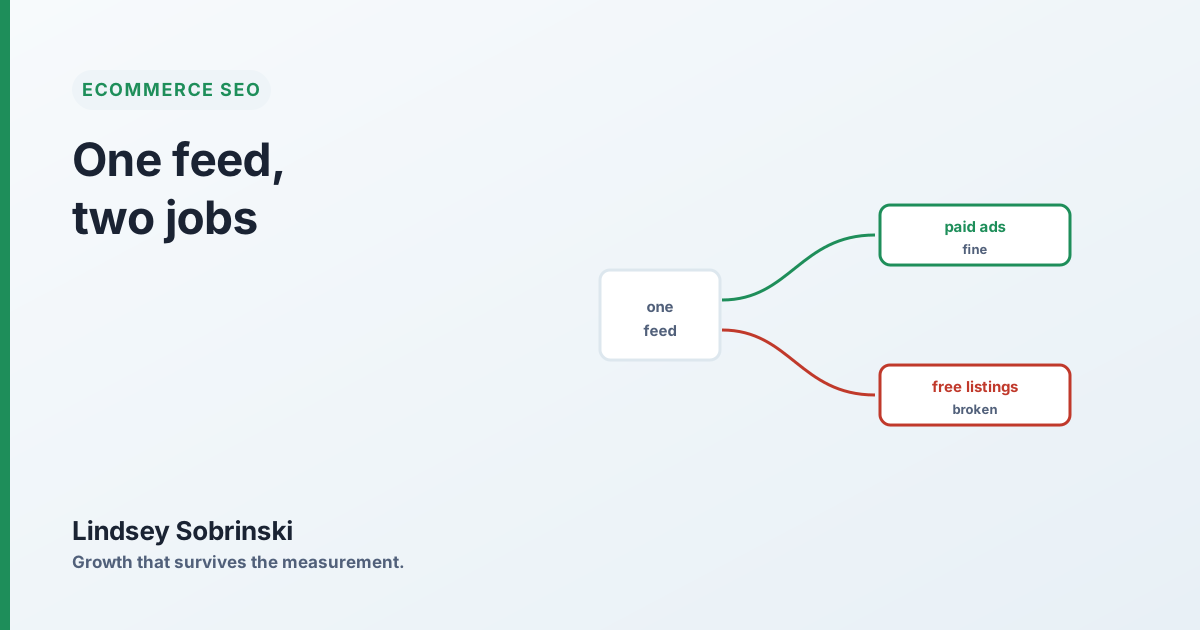
Free Shopping listings are one of the best placements in ecommerce: high-intent shoppers, direct revenue, no cost per click. And on a lot of sites they’re quietly broken, not because anyone neglected them on purpose, but because the same product feed built for paid Shopping ads is being asked to power organic listings too, and the two jobs pull in opposite directions.
The tell is subtle. Paid Shopping looks fine, so no one digs into the feed. Meanwhile the free listings underperform, and because nobody owns the organic side, the cause never gets diagnosed. It’s a feed problem hiding behind a healthy-looking paid dashboard.
One feed, two conflicting jobs
Paid and organic Shopping reward different things, and a feed tuned for one undercuts the other.
A feed built for paid ads often carries titles engineered for ad matching, stuffed with modifiers, brand prefixes, size and color tokens, keyword variants, because that’s what helps a Shopping ad surface for the right queries. Free listings do better when the title mirrors the clean, human product name shown on the page, and when the description matches the on-site copy rather than a separate marketing block written for ads.
When a single paid-built feed drives both surfaces, the organic side inherits all the paid optimizations as liabilities: titles that don’t match the on-page name, descriptions that diverge from the product page, and data quirks that weaken relevance. The free listings are running on someone else’s optimization.
The problems that pile up
A Merchant Center audit on one retailer surfaced exactly this pattern, and the specific issues are common enough to check for on any site.
Titles that don’t match the page. The feed title was a modifier-stuffed string; the on-site H1 was the clean product name. That mismatch weakens the relevance signal for free listings, which favor alignment between feed and page.
Descriptions that diverge. The feed carried separate description copy, sometimes truncated or reformatted, instead of the clean on-site description, stripping out intent signals the product page actually communicated.
Products in the feed that aren’t live. Items that were archived, unpublished, or discontinued on the site were still in the feed, creating eligibility and trust risk.
Availability that’s stale. Availability wasn’t mapping cleanly from live product state, so the feed could advertise stock reality that no longer held.
Patchy identifiers. Inconsistent GTIN coverage undercut how confidently Google could match and trust the products.
Individually each is minor. Together they quietly cap what free listings can do.
Separate the feeds
The cleanest fix is to stop making one feed serve two goals. Create a dedicated organic feed for free listings, keeping the same product IDs as the paid feed but optimizing it for the organic surface: titles sourced from the on-site product name, descriptions mirroring the clean on-page copy, only live and valid products included, availability mapped from real product state, and identifiers filled in consistently. Destination controls keep each feed serving the surface it’s built for, so the paid team’s Shopping-ads feed stays exactly as it is.
Now the two optimization goals stop fighting inside one file. Paid keeps its ad-tuned feed; organic gets a feed that mirrors the site and earns its eligibility.
A product feed built for paid ads and pointed at free listings is optimizing the wrong thing on the organic surface. Two goals, one file, and the organic side always loses the compromise.
Who owns it
The reason this persists is ownership. The feed is built by or for the paid team, engineering maintains the pipes, and no one owns the organic side, so free listings run on data shaped for a different objective and nobody notices. This is where SEO and paid media meet, and it needs a named owner: typically SEO or ecommerce, with a clear mandate to keep the organic feed aligned to on-site data and clean, working alongside paid rather than inheriting their feed.
It’s an unglamorous fix, feed configuration, not content, but free listings are direct revenue at no media cost, and they’re often the highest-ROI thing you can repair in an afternoon of feed work. Check whether one feed is doing both jobs on your site. If it is, the organic half is almost certainly the one losing.