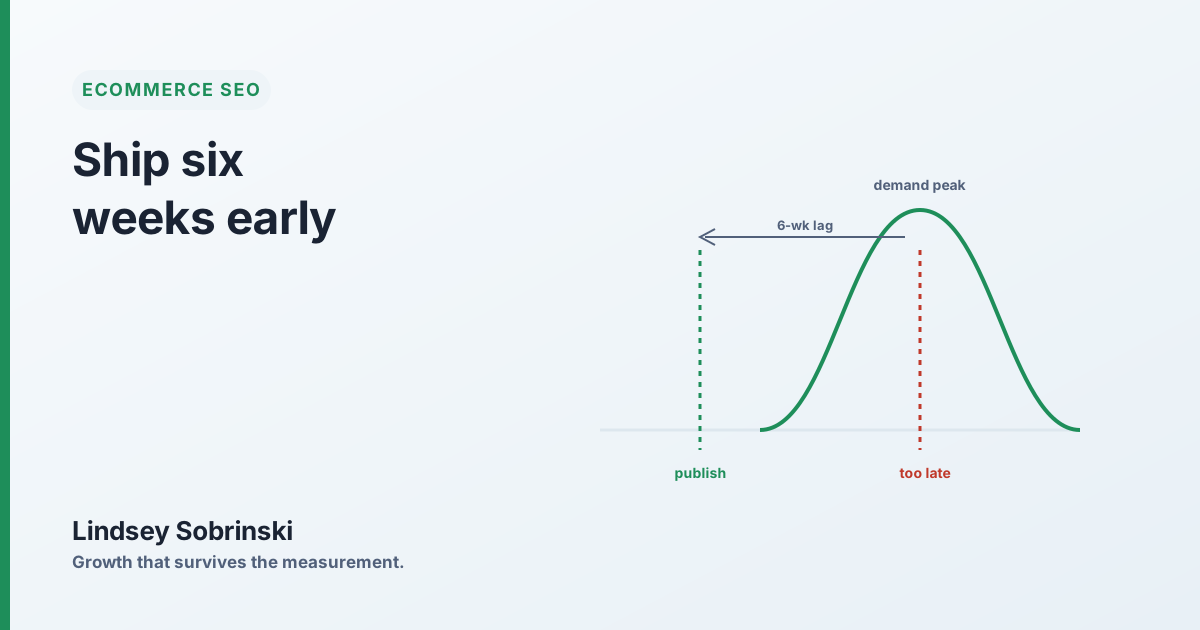
Here’s how seasonal content usually fails, and it has nothing to do with the writing. The page is good. It’s well-researched, well-optimized, genuinely useful. It just went live the week the season started, and by the time it climbed into a rankable position, the searches were already draining away. It’ll do beautifully next year, for about two weeks, and then miss the window again if nobody fixes the timing.
Seasonal SEO is an operations problem wearing a content costume. The content can be perfect and still lose, because there’s a lag between publishing and ranking, and seasonal demand windows are narrow enough that the lag eats the whole opportunity.
Ranking isn’t instant, and seasons don’t wait
Two facts collide here. The first: after you publish, a page doesn’t rank immediately. It has to be crawled, indexed, and then evaluated against everything already ranking, a process that typically takes several weeks before a page settles into position, longer on competitive terms.
The second: seasonal demand is concentrated. Some categories spike for a single month and are gone. A page that goes live on day one of a four-week season is still climbing while the demand is already halfway spent. By the time it could rank, there’s nothing left to rank for until the same window opens a year later.
Put those together and the conclusion is unavoidable: if the content isn’t live and indexed before the window opens, it can’t do its job during the window.
Publish ahead of the window, not into it
The discipline is to build the calendar backward from demand, not forward from capacity. For each seasonal category: find when the searches actually spike, from trend data, not from assumption, subtract the four-to-six-week publish-to-rank lag, and make that the live-by date. Then subtract writing and review time to get the start date.
On one retailer’s seasonal analysis, the windows were tighter and more specific than anyone had planned for: one occasion peaked across three months, another for a single month, a third for a six-week spring stretch. Each needed a completely different publish date, and content produced “when we got to it” was landing live right as the windows were closing. The fix wasn’t better content. It was a calendar anchored to each category’s peak, with everything backdated from there.
A seasonal page published at the peak has already missed it. The searches are happening now; the ranking is weeks away. The only way the two line up is to publish before the demand arrives.
Refresh beats rebuild
There’s a shortcut that also happens to be the stronger play: where a page for this season already exists from last year, refresh and re-promote it rather than publishing a brand-new URL. An existing page carries authority and history, so it re-ranks faster than a fresh one starting from zero, which means its effective lead time is shorter and its ceiling is higher.
The timing rule still holds. Refresh the page four to six weeks before the window, not at the peak. You’re accelerating something the engine already knows instead of introducing something it has to discover, but it still needs runway to climb.
The operational takeaway
Treat seasonal categories as what they are: deadlines, not evergreen backlog. Every seasonal piece gets a live-by date derived from its category’s peak minus the ranking lag, and a start date derived from that minus production time. Miss the start date and you don’t have a content problem, you have a page that will publish beautifully into an empty room.
The content team’s instinct is to sequence by what’s ready. Seasonal SEO has to sequence by when the demand shows up. Build the calendar from the peaks backward, ship each piece six weeks early, and let the pages be ranking and waiting when the searches finally arrive, instead of chasing a window that’s already closing.